

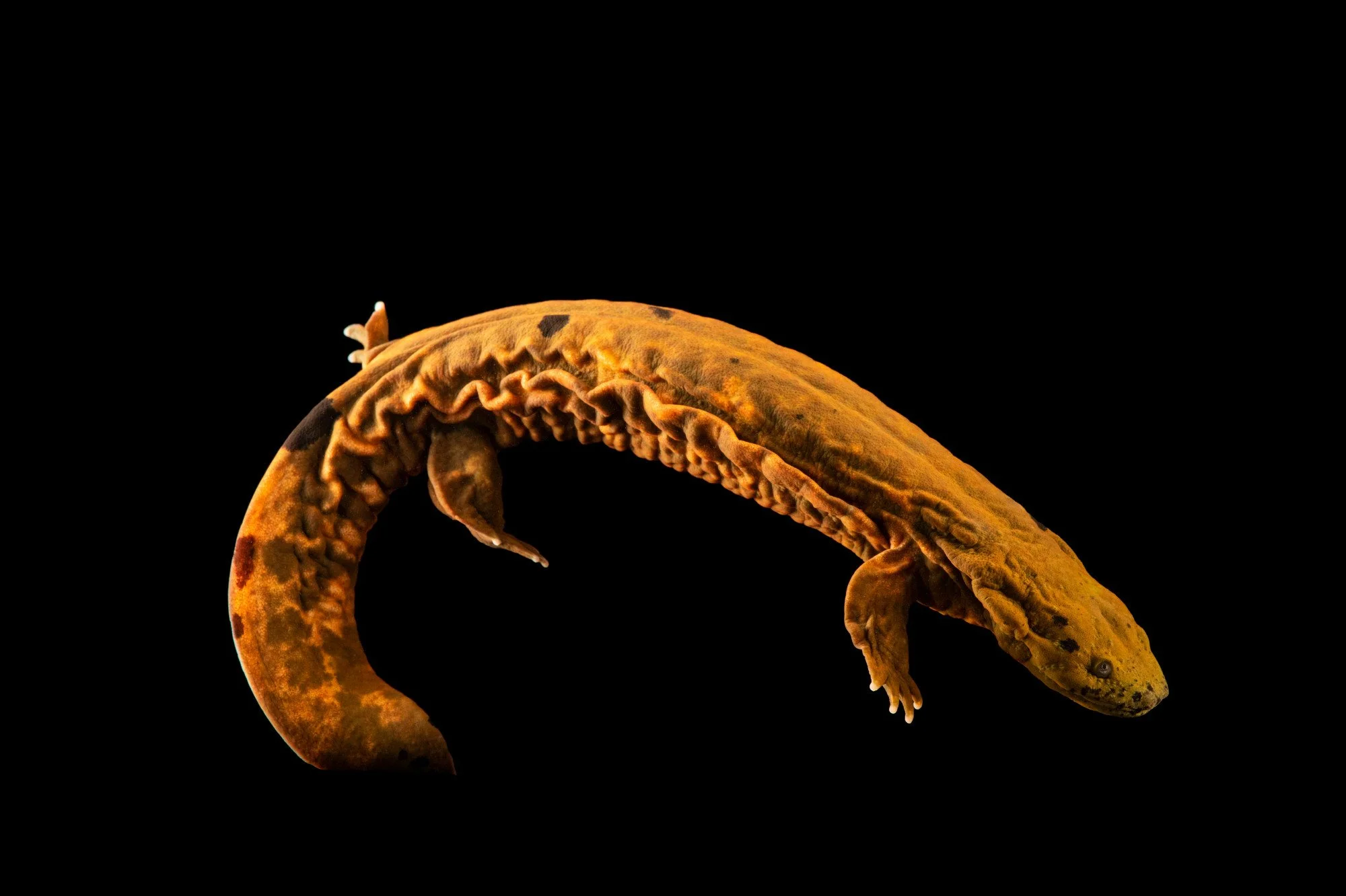
Photo by Joel Sartore
Eastern Hellbender | Cryptobranchus alleganiensis
Status: IUCN: Vulnerable; USFWS: Proposed As Endangered
CF Status: Rearing from 2025-present. What does this term mean?
-
The Eastern Hellbender (Cryptobranchus alleganiensis alleganiensis) is one of the largest amphibians in North America, reaching lengths of up to 29 inches. Despite its impressive size, most people will never encounter one. Hellbenders are nocturnal, secretive, and intensely loyal to their chosen homes, often spending decades beneath the same large, flat rock.
They are also incredibly long-lived. Individuals in captivity have lived more than 30 years, and scientists believe wild hellbenders may exceed 50 years of age. When you see one, it’s hard not to feel like you’re looking at something prehistoric—and honestly, that’s not far from the truth.
Their loose, wrinkled skin isn’t just part of their strange charm. Hellbenders breathe entirely through their skin, absorbing oxygen directly from the surrounding water. Those folds increase surface area, making them perfectly adapted to life in cold, fast-moving, oxygen-rich streams. The downside? Even small declines in water quality can have devastating effects.
Hellbenders have earned an impressive collection of nicknames over the years, including snot otter, lasagna lizard, ground puppy, mud cat, mud dog, grampus, Allegheny alligator, and devil dog. While none of these names are particularly flattering, they all hint at the same thing—this is an animal that looks like it crawled straight out of another era.
-
Eastern Hellbenders are found in clear, fast-flowing streams across 15 Appalachian states. Their range stretches from southwestern and south-central New York, south through the Appalachian Mountains into northern Georgia and Alabama, and west into Illinois and Missouri.
Today, the strongest remaining populations occur in Kentucky, Tennessee, Virginia, and North Carolina, where cold mountain streams still run over rocky beds. They are also found in the Allegheny and Susquehanna River drainages of New York and Pennsylvania, along with tributaries of the Ohio and Tennessee rivers.
The single most important feature of adult hellbender habitat is large, flat, submerged rocks. These slab rocks provide shelter, nesting sites, and protection from predators and strong currents. Where these rocks disappear, hellbenders soon follow.
-
Once an adult hellbender claims a suitable rock, it rarely leaves. These salamanders are highly territorial and may defend the same den for decades. Emerging mostly at night, they feed primarily on crayfish and other aquatic prey.
Breeding occurs in late summer and early fall, and here’s a fun crossover fact for fish lovers: male hellbenders guard their nests, much like many fish species do. The male stays with the eggs, fanning them with his tail to keep oxygenated water flowing until they hatch.
Larval and juvenile hellbenders, much smaller and more vulnerable, live hidden among gravel and cobble in the stream bed until they are large enough to claim a slab rock of their own.
-
Despite their toughness and long lifespan, Eastern Hellbender populations are in serious decline. Over the past 30 years, scientists estimate losses of 30–50% across much of their range. Of 626 historically documented populations, approximately 41% are believed to be extirpated, with another 36% actively declining. In states like Illinois and Indiana, hellbenders have nearly disappeared.
The causes are closely tied to human activity. Sedimentation from agriculture, logging, erosion, and construction fills the spaces beneath rocks where hellbenders live and reproduce. Dams warm the water, slow current, and reduce oxygen levels. Pollution further stresses a species that depends entirely on clean, cold water to breathe.
Disease adds another layer of pressure. Chytrid fungus, now widespread in Appalachian streams, can weaken amphibians over time—especially skin-breathing species like hellbenders. Ranavirus can be even more severe, causing rapid illness and die-offs, particularly among juveniles. Both diseases hit hardest in degraded waterways.
-
In September 2024, Hurricane Helene delivered a devastating blow to Eastern Hellbender populations in Tennessee, Virginia, and North Carolina. These states were considered strongholds for the species, supporting some of the healthiest remaining populations.
Record flooding scoured streambeds, shifted massive slab rocks, and buried critical habitat under sediment. Many populations are now believed to have suffered significant losses, making post-hurricane monitoring urgent and essential. Understanding how these populations respond—and whether they can recover—will be critical to the future of the species.
Although the Eastern Hellbender is not yet federally listed across its entire range, momentum is building. In 2011 the Ozark Hellbender (Cryptobranchus alleganiensis bishopi) - a subspecies of the Eastern Hellbender was listed as endangered. In 2021, Missouri populations of the Eastern Hellbender were also listed as endangered as a Distinct Population Segment. In 2024, the U.S. Fish and Wildlife Service proposed listing the Eastern Hellbender as endangered range-wide, a move that could unlock vital protections and conservation funding.
Currently, the species is considered endangered or of special concern in nearly every state it inhabits.
-
The Eastern Hellbender is more than a strange creature hiding under river rocks. It is a living indicator of stream health. Where hellbenders thrive, clean water flows—not just for wildlife, but for people.
Protecting this ancient salamander means protecting the rivers that carve through Appalachia, the ecosystems they support, and the communities that depend on them. Beneath the current, under cold, rushing water, the hellbender still holds on. Whether it continues to do so may depend on what we choose to protect next.
There is reason for hope. Conservation programs are expanding, and dedicated organizations are stepping up. In 2025, Conservation Fisheries extended its work beyond fish to include aquatic amphibians, successfully collecting Eastern Hellbender eggs for the first time.These young hellbenders will be raised for two years—long enough to be PIT-tagged and released back into the wild. This “head-start” approach improves survival during their most vulnerable life stage and provides researchers with valuable long-term data.
Native Range
South-western/south-central New York, south through the Appalachian Mountains to northern Georgia, Alabama, and west to Illinois and Missouri.
Threats


Sedimentation, reduced water quality, habitat destruction, habitat fragmentation, disease, and direct mortality. What do these terms mean?

Spawning Habitat Preferences: Fall spawners, typically from late August through October. Males select and defend a den for spawning. A female will come in and lay over 300 eggs with the male. Males can spawn with multiple females. These eggs stay in the den over the winter. It takes about 6-10 weeks for the eggs to hatch and another 6-12 weeks before the larvae are ready to eat - just in time for spring.
In Partnership With: Cherokee National Forest Service

Photo by Joel Sartore.
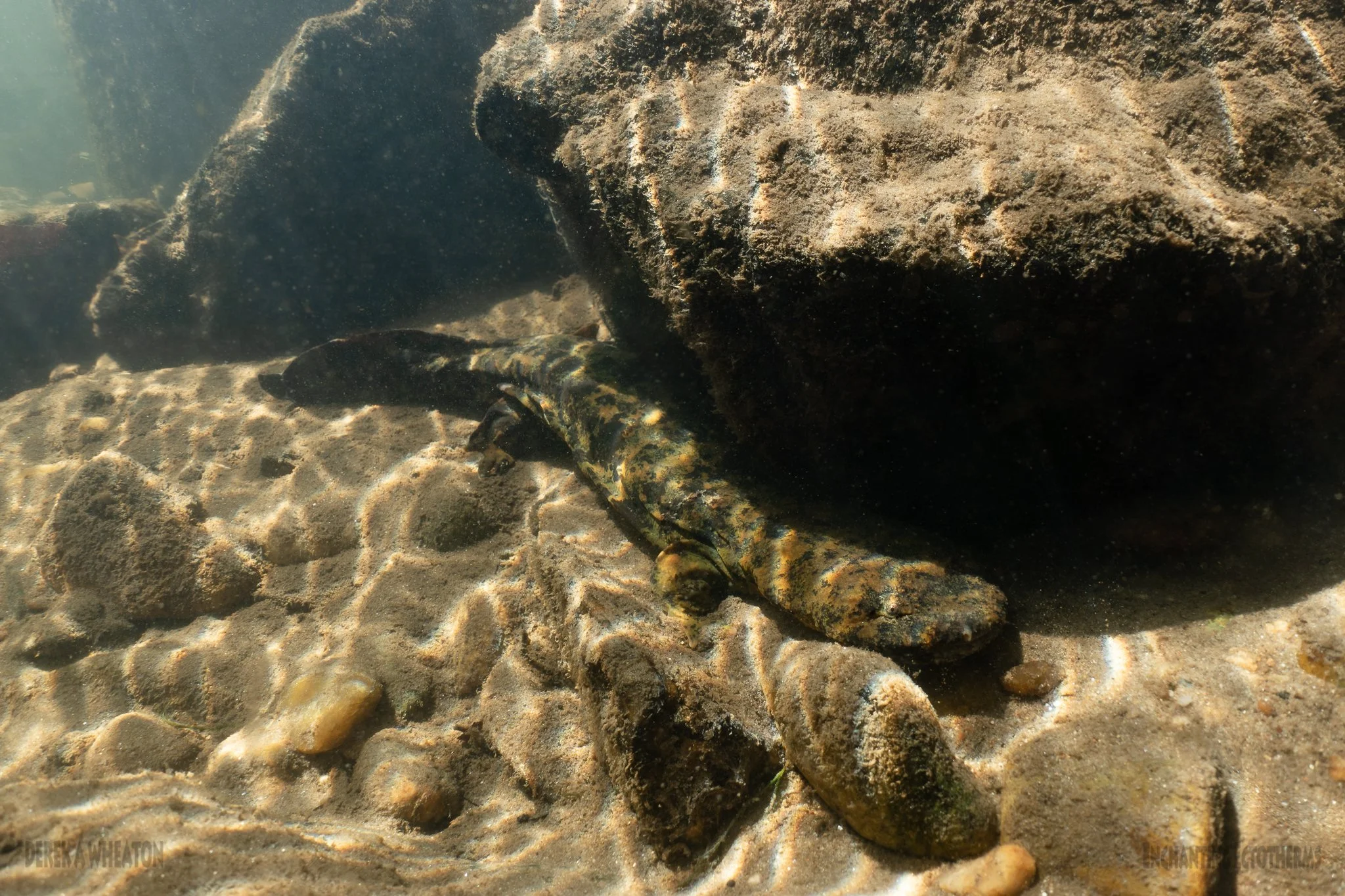
Photo by Enchanting Ectotherms.

Photo by Enchanting Ectotherms.